- About Us
- Programs
- International School
- Support Us
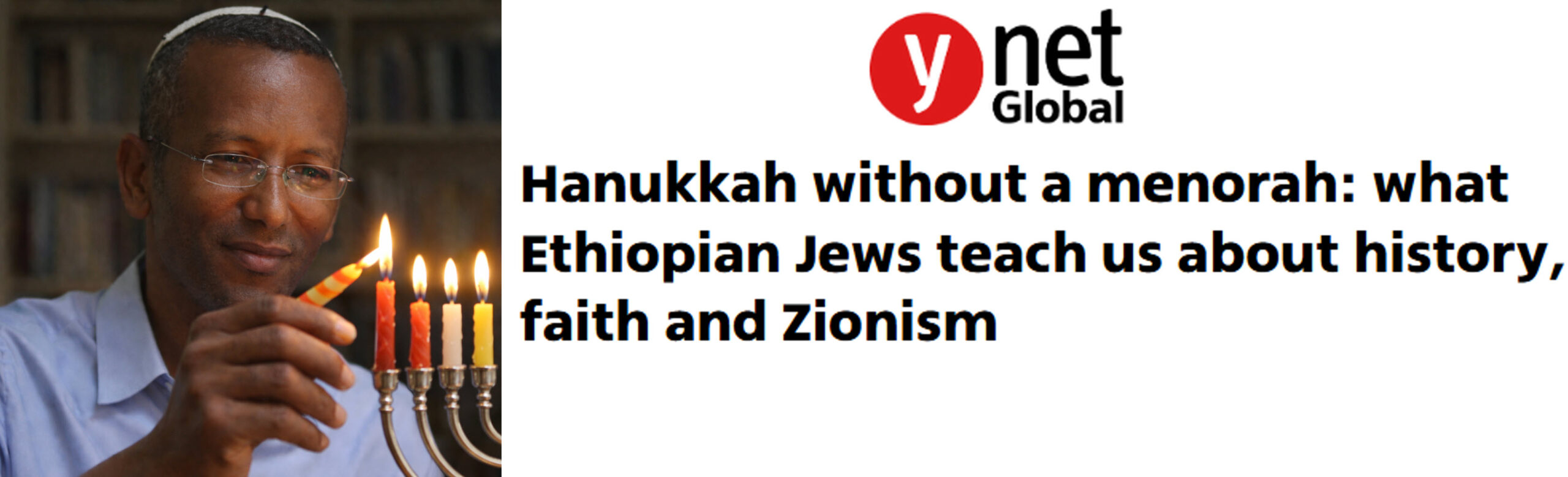
YNET published the article “Hanukkah without a menorah: what Ethiopian Jews teach us about history, faith and Zionism” by Rabbi Dr. Sharon Zeude Shalom, founder and director of the International Center for the Study of Ethiopian Jewry at Ono Academic College. In the article, Rabbi Dr. Shalom challenges common assumptions about Hanukkah by showing that Ethiopian Jews did not experience the holiday through rabbinic ritual or the miracle of the oil, but through the historical narrative preserved in the Book of the Maccabees, which was included in their sacred canon.
He explains that while rabbinic Judaism emphasized Hanukkah as a miraculous-religious celebration centered on the menorah, Ethiopian Jewish tradition understood it as a national-historical story of human courage, resistance, and responsibility. This difference reflects two deeper modes of consciousness: miraculous religious consciousness, which relies on divine intervention, and historical consciousness, which emphasizes human action within history. Ethiopian Jews, he argues, preserved the latter.
Rabbi Dr. Shalom connects this distinction to contemporary Israeli debates over military service, especially within ultra-Orthodox society. He questions whether it is possible to disengage from historical responsibility—such as enlistment and collective sacrifice—while still expecting national survival. In contrast to modern ultra-Orthodox rhetoric, he notes that Ethiopian Jewish spiritual leaders (the Kesim) never separated faith from action or Torah from responsibility.
Drawing on scholars, poets, and Zionist thinkers, Rabbi Dr. Shalom argues that Zionism did not reject Judaism but rather reactivated Jewish historical consciousness after centuries of exile shaped by reliance on miracles. He highlights Ethiopian Jewry’s unique historical achievement—the establishment of the Kingdom of the Gideons in Ethiopia—as evidence of a tradition that combined faith with sovereignty, initiative, and human agency.
He concludes by warning that privileging either consciousness alone is dangerous. Historical consciousness without faith risks emptiness, while religious consciousness detached from history risks passivity and denial. The enduring lesson of Hanukkah, as preserved by Ethiopian Jews, is the necessity of balance: faith joined with action, Torah joined with responsibility, inner spiritual light joined with outward commitment. Only through this integration, he argues, can Israel generate a true and lasting light—for itself and for others.
The original article in English can be read here: https://www.ynetnews.com/jewish-world/article/bjwxme6gbl