- About Us
- Programs
- International School
- Support Us
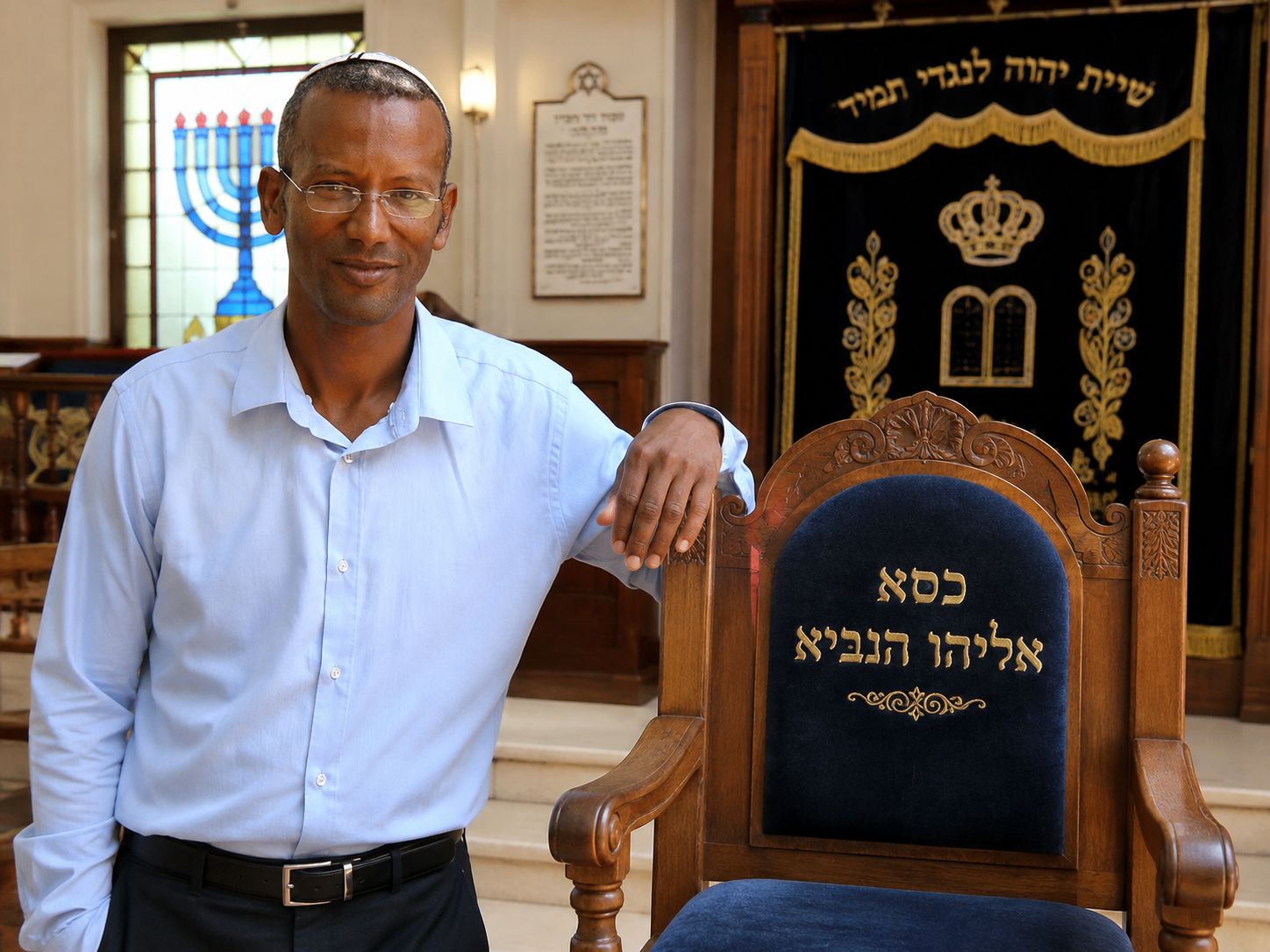
Rabbi Dr. Sharon Shalom, the founder and director of the International Center for the Study of Ethiopian Jewry at Ono Academic College, recently wrote an article for the Times of Israel, entitled “Why Did the Kessim Laugh at Elijah’s Chair?”
In this new piece, Rabbi Shalom begins with a striking moment from Ono Academic College’s Beit Midrash of Bete Israel Rabbis and Kessim. When one of the Kessim asked why synagogues have a special chair for Elijah the Prophet at a brit milah, the other Kessim laughed. To them, both circumcising a child inside a synagogue and doing so on Shabbat seemed deeply puzzling. In Bete Israel tradition, circumcision involves blood and ritual impurity and therefore belongs outside sacred space; when the eighth day falls on Shabbat, the circumcision was traditionally postponed. Rabbinic Judaism developed almost the opposite practices.
Rabbi Shalom uses this encounter to explore how different Jewish traditions can develop very different understandings of holiness while remaining equally committed to the covenant. He traces the rabbinic tradition of Elijah’s chair to the idea that Elijah, having accused Israel of abandoning the covenant, was required to witness every circumcision as testimony to Israel’s continued faithfulness. Over time, circumcision also moved from the family home into the synagogue, and Elijah’s chair became a powerful communal symbol of the enduring covenant.
But the article’s larger concern is not the history of the chair. It is what happens when different Jewish traditions meet and each assumes that its own religious practice represents the only authentic expression of Torah. Drawing on the Netziv, Rabbi Shalom warns that religious meticulousness can become dangerous when it produces suspicion of those who practice Judaism differently. The problem, he argues, is not halakha itself, but what happens when concern with religious boundaries overwhelms human relationships and responsibility.
He illustrates this through the story of a young Ethiopian Israeli yeshiva student whose increasing halakhic observance gradually made it difficult for him to eat in his parents’ home. Reading Rabbi Shalom’s From Sinai to Ethiopia helped him rediscover a way to sit beside his father and accept a piece of injera from him—a simple Bete Israel gesture of affection and blessing. “I felt that I had received my father back,” the student told him, “and that I had received myself back.”
Rabbi Shalom contrasts this experience with the traditional Bete Israel laws of ritual purity. Although those laws created clear physical boundaries—for example, a mother remained in a special maternity dwelling after childbirth—the separation did not mean social exclusion. On the contrary, it created communal obligations: neighbors brought food, assisted the family, and cared for the mother. Religious boundaries, in other words, were intended to generate responsibility rather than alienation.
This leads to the central question of the article: when different Jewish traditions encounter one another, are they guided primarily by fear or by love? Rabbi Shalom argues that Israel should become more than the geographical gathering place of Jewish exiles. It should become a place where ancient Jewish traditions learn to listen to and enrich one another—not by erasing their differences, but by discovering that what binds them can be deeper than what separates them.
Bete Israel tradition, he concludes, should therefore not be regarded simply as a challenge for Israeli Judaism to accommodate. Its understanding of covenant as grounded in fidelity, responsibility, and trust has something important to teach Judaism as a whole: it is possible to remain deeply faithful to one’s own tradition without turning another Jewish tradition into a threat.
Rabbi Shalom finally returns to Elijah. The biblical Elijah is destined to “turn the heart of the fathers to the children, and the heart of the children to their fathers.” His task is not to eliminate differences, but to repair relationships across them. Perhaps, Rabbi Shalom suggests, this is also the challenge facing Jewish society today—and one of Bete Israel’s distinctive gifts to the Jewish people: not a way to abolish our differences, but a way to live with them in fidelity to the covenant, until what binds us becomes deeper than what divides us.