- About Us
- Programs
- International School
- Support Us
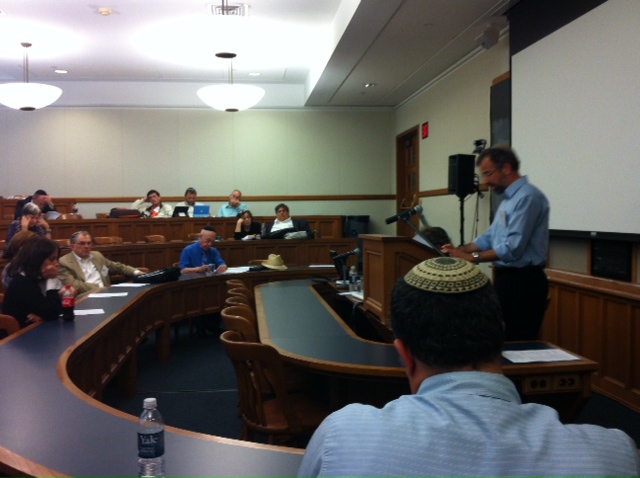
Prof. Ron S. Kleinman, of the Faculty of Law at Ono Academic College, participated in the 17th International Conference of The Jewish Law Association held at Yale University in New Haven, Connecticut, USA, from July 30 through August 2, 2012. Professor Kleinman has chaired the Israel Committee of the Jewish Law Association since 2008, and was elected for another two-year term at the conference.
The theme of the Yale conference was “The Interaction of Jewish and Other Legal Systems.” Several dozen scholars of Jewish law and related fields (Talmud, Bible, philosophy of halakha, Jewish history, etc.) from many countries, especially Israel and the U.S., gathered to examine the subject a range of perspectives, using a variety of research disciplines.
Professor Kleinman lectured on “The Halakhic Validity of Civil Law and Civil Adjudication in Israel: The Position of Rabbi Israel Grossman in Responsa Mishkenot Israel as a Test Case.” His lecture dealt with the approach of the ultra-Orthodox adjudicator and judge, Rabbi Israel Grossman (1922-2007) to Israeli civil law and the Supreme Court in ruling dealing with issues of life in apartment buildings, planning and construction.
Examination of Rabbi Grossman's rulings in these matters revealed some key points:
The lecture examined the assumptions underlying these arguments advanced by Rabbi Grossman and proposed a way to see his methodology in a wider framework, as part of the ideological attitude toward the State of Israel and its laws.