
- About Us
- Programs
- International School
- Support Us
On this Yom HaShoah, Ono Academic College’s International Center for the Study of Ethiopian Jewry remembers not only the destruction of Jewish life in Europe, but also the resilience of Jewish communities in other regions, such as Ethiopia, whose stories are still being uncovered.
A recent video (https://www.facebook.com/share/r/16ycBJgR16/) highlights a powerful and lesser-known dimension of Holocaust memory—bringing to light the experiences, voices, and historical consciousness of Ethiopian Jews in relation to the Shoah.
As per the video, in 1936, Italian occupation of Ethiopia brought Fascist rule—aligned with Nazi Germany—into Ethiopia, and by 1940 racial laws were formally applied to the Beta Israel (Ethiopian Jewish) community. According to the account presented, these policies escalated beyond discrimination into violence, including the execution of 44 communal leaders, marking a severe rupture in the life of Ethiopian Jewry. Yet this period of persecution was relatively brief: in 1941, Ethiopian and Allied forces succeeded in expelling the Italians. A key figure in this effort was Orde Wingate—also known for his work in pre-state Israel supporting Jewish defense forces—who helped organize the Gideon Force, a guerrilla campaign that included and empowered local fighters, among them Ethiopian Jews, contributing directly to the defeat of Fascist control and the restoration of sovereignty.
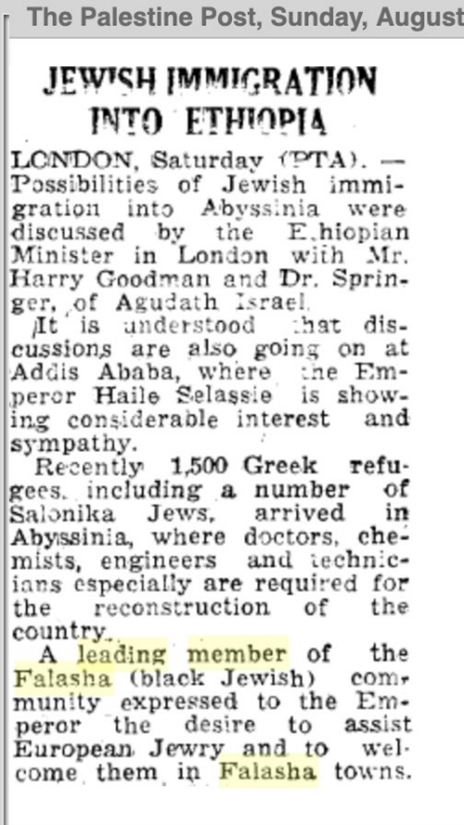
Following the liberation, Haile Selassie was restored to the throne and is described as taking a sympathetic and active stance toward the plight of European Jewry during the Holocaust. As reflected in contemporaneous reporting, including the Palestine Post (see article here), Ethiopian officials and Jewish community leaders discussed the possibility of Jewish immigration to Ethiopia, with expressions of willingness to receive European Jews into Beta Israel communities and assist in their resettlement. This narrative positions Ethiopia not only as a site of wartime suffering under Fascist rule, but also as a potential refuge—however constrained by the realities of the time—for Jews seeking escape from Europe.