
- About Us
- Programs
- International School
- Support Us
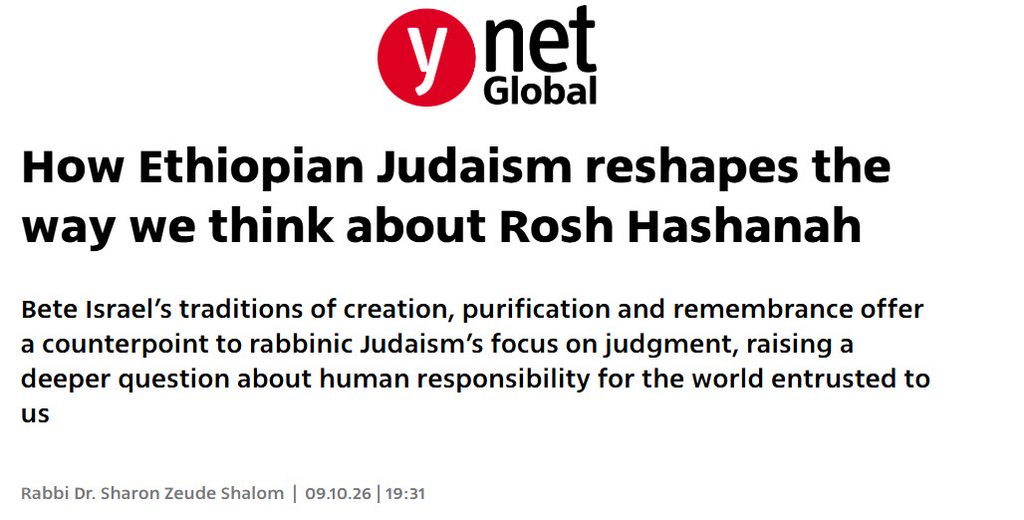
YNET, the website of Israeli daily newspaper Yediot Achronot, published the article, “How Ethiopian Judaism Reshapes the Way We Think About Rosh Hashanah,” by Rabbi Dr. Sharon Shalom, founder and director of the International Center for the Study of Ethiopian Jewry at Ono Academic College.
In the article, Rabbi Shalom explores how the Bete Israel tradition offers a distinctive perspective on Rosh Hashanah and, more broadly, on humanity’s place in creation. Bete Israel developed for centuries outside the world of the Mishnah and Talmud, creating its own Jewish religious tradition rooted in the Orit, prayer, the leadership of the kessim, and communal practice. Rather than viewing this as something incomplete, Rabbi Shalom presents it as a different Jewish path with its own theological center of gravity.
He begins with the Torah’s account of creation. The world—light and darkness, land and sea, plants and animals—exists and is declared good before human beings appear. Rabbinic Judaism, while preserving this perspective, increasingly emphasizes human agency and responsibility: people interpret Torah, make religious decisions, repent, and ultimately stand before God in judgment.
Rosh Hashanah brings the contrast into particularly sharp focus. In Bete Israel tradition, the holiday is known as Berhan Seraka, “the dawning of the light,” recalling the first light of creation. It is also associated with Abraham and the binding of Isaac. Traditional observances included purification in a river, dressing in clean white clothing, communal prayer and readings led by the kessim, and sharing masawait, special bread prepared for the holiday. These practices place creation, purification, memory, community, and covenant at the center of the day.
Rabbi Shalom also turns to Psalms 148 and 150, where the sun, moon, stars, mountains, trees, animals, people, and ultimately all creation join in praising God. He compares this vision to an orchestra: the human voice is important and carries a distinctive responsibility, but it is not the only voice.
Rabbi Shalom does not ask readers to choose between Ethiopian and rabbinic traditions. Instead, he argues that each preserves an essential truth. Rabbinic Judaism powerfully reminds human beings of their responsibility for their actions, while Bete Israel reminds them that they entered a world that preceded them and do not own it. Together, these perspectives add a second question to the traditional introspection of Rosh Hashanah. Alongside asking what judgment awaits each individual, Rabbi Shalom asks us to consider a broader moral question: What will be the fate of the world in human hands?
The full article can be read at: https://www.ynetnews.com/jewish-world/article/h1wbahxkgl