- About Us
- Programs
- International School
- Support Us
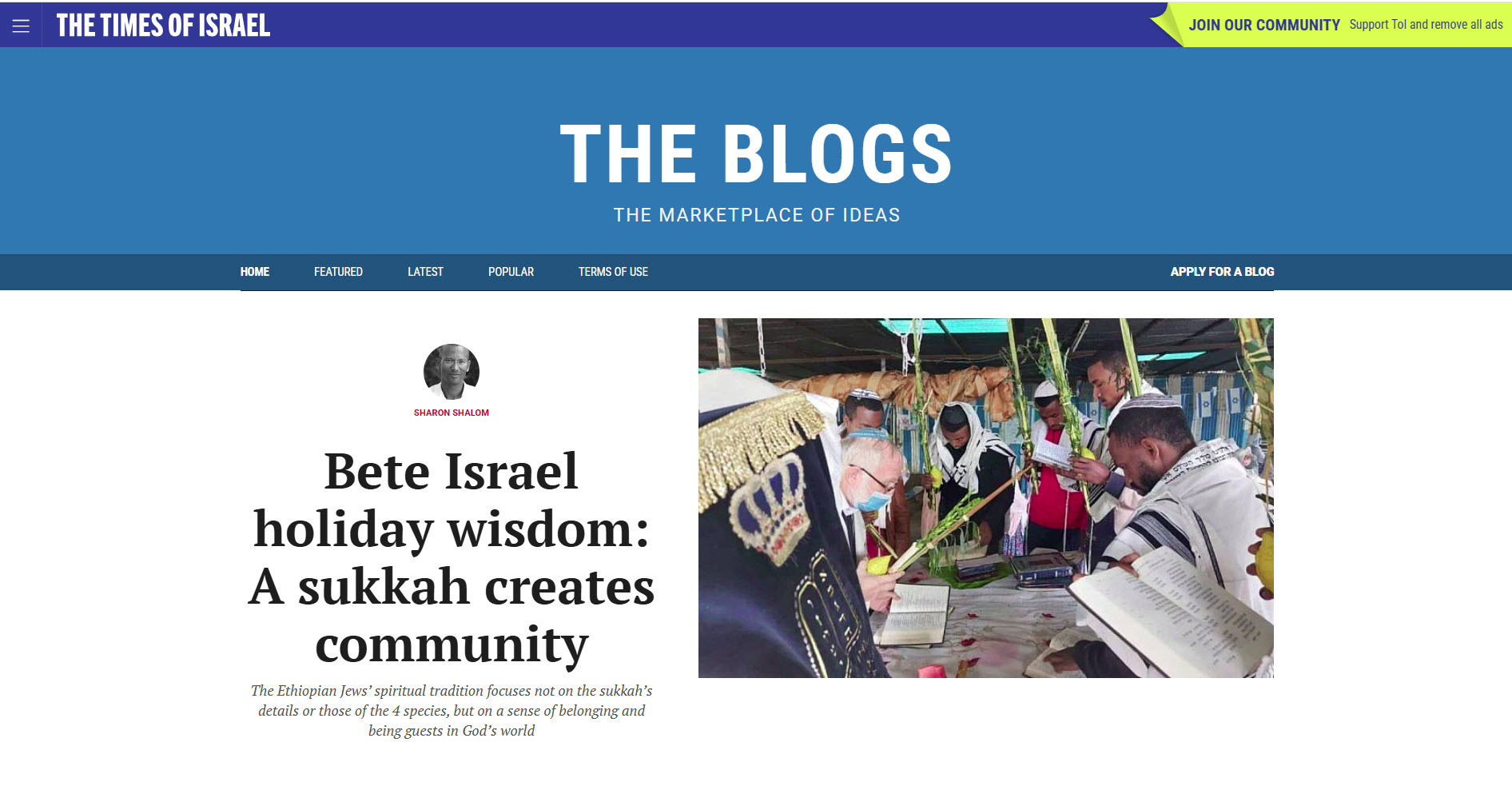
Rabbi Dr. Sharon Shalom, the founder and director of the International Center for the Study of Ethiopian Jewry at Ono Academic College, recently wrote an article in the Times of Israel newspaper, entitled “Bete Israel Holiday Wisdom: A Sukkah Creates Community.” The article was chosen as the paper’s featured article on September 23, 2026.
In this new piece, Rabbi Shalom draws on the Bete Israel tradition of Sukkot to explore the meaning of hospitality, community, and belonging. He begins with a paradox in the Jewish calendar: Rosh Hashanah and Yom Kippur call upon us to return—to God, to ourselves, and to our identity—but immediately afterward, Sukkot asks us to leave the security of our homes.
Rabbi Shalom explains that in Ethiopia, Bete Israel celebrated Sukkot differently from the familiar rabbinic tradition. Rather than each family constructing its own sukkah, volunteers built one large sukkah in the synagogue courtyard for the entire community. The emphasis was not on “my sukkah,” but “our sukkah”—a shared place for prayer, meals, hospitality, and fellowship. Similarly, the plants associated with the holiday were used to decorate the sukkah rather than as the separate mitzvah of the four species familiar from rabbinic Judaism.
This communal sukkah leads Rabbi Shalom to a deeper question: Who is really the host and who is the guest? Sukkot takes us out of our permanent homes and reminds us that ultimately we are all guests in God’s world. True hospitality, therefore, does not require us to surrender our identity. A strong sense of who we are can actually make it easier to open our doors to others.
Drawing on experiences from his own life—from his Ethiopian village, his journey through Sudan and arrival in Israel, and later his years in the United States—Rabbi Shalom describes how Jews separated by geography, culture, language, and appearance repeatedly recognized one another not as strangers, but as brothers and sisters. Hospitality becomes more than generosity; it expresses the recognition that someone who initially appears different may nevertheless belong to the same human and spiritual family.
He captures this idea through an Ethiopian teaching: rather than thinking only about “building bridges” between people standing on opposite sides, we should remember that we are standing beside the same river and drinking from the same source. Difference does not have to disappear for genuine belonging to exist. The communal sukkah similarly creates a space in which people can remain different while sharing the same shelter.
Rabbi Shalom connects this idea to what he calls a “consciousness of redemption.” A society shaped primarily by destruction tends to ask who is above and below, who belongs and who is excluded. Redemption offers another possibility: maintaining identities and boundaries without turning them into walls. The sukkah reminds those who have gained freedom that freedom does not mean becoming masters over others. Instead, we recognize that we too remain guests.
Sukkot therefore completes the spiritual journey of Tishrei. After returning home through Rosh Hashanah and Yom Kippur, we leave home again in order to understand what home truly means. Rabbi Shalom concludes that redemption begins when we ask not only who is right or wrong, but what responsibility each of us has for repairing our shared home. The message of the Bete Israel sukkah is ultimately simple and powerful: we are all guests in God’s world, we all drink from the same river, and there must be room for all of us beneath the same shade.