- About Us
- Programs
- International School
- Support Us
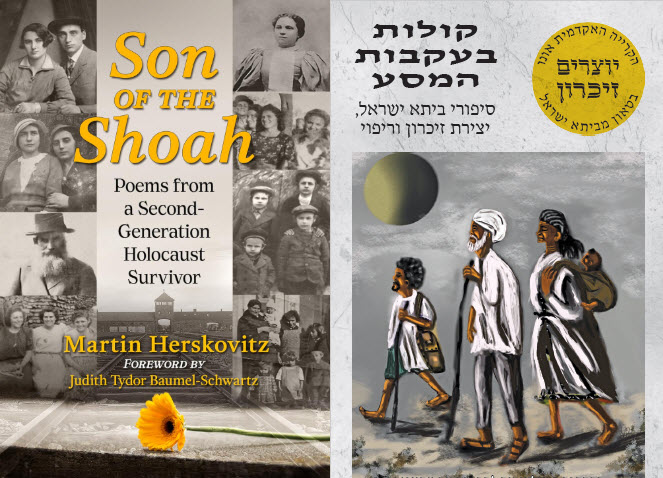
Marty Herskovitz and his Creating Memory Foundation are longtime collaborators with Ono Academic College’s International Center for the Study of Ethiopian Jewry. Together, they have built an ambitious educational partnership that bridges remembrance and pedagogy. Ono and Creating Memory jointly developed a comprehensive study curriculum about Ethiopian Jewry for middle and high school students in the English-speaking world—a program that, over the past year, has been successfully adapted for the Israeli educational system. Their partnership also extends to a new publication, Voices Following the Journey: Stories of Beta Israel, Creating Memory and Healing, a collection of essays, poems, and artwork by first- and second-generation Ethiopian Israelis exploring trauma, identity, and renewal. The book’s launch, with Deputy Knesset Speaker MK Moshe Solomon, will mark another milestone in this shared vision of memory as a pathway to healing.
Marty Herskovitz’s latest work, Son of the Shoah: Poems from a Second-Generation Holocaust Survivor, continues this journey from communal remembrance to personal reclamation. The book transforms inherited trauma into art. Written with unflinching honesty, Herskovitz explores what it means to grow up in the shadow of catastrophe—where silence, guilt, and absence fill the domestic space once meant for love. His opening prose essay “My Journey to Remembrance” situates poetry as a means of catharsis, offering a voice to the voiceless child who “could not find a true feeling of belonging.” The verses that follow—structured in cycles of “Stories of Forgetting and Re-Remembering,” “Stories of Desolation and Solace,” and “Stories of Hope and Healing”—move the reader from the unspoken weight of generational trauma toward the slow emergence of compassion and acceptance.
The poems themselves are distinguished by their simplicity and restraint, yet they pulse with layered emotion. In “Eclipse,” Herskovitz imagines Holocaust knowledge as “encrypted on my soul,” while “Photographs” captures the ache of lost ancestry—“I don’t have any pictures of my uncles who died in Auschwitz.” Later poems like “Renewal” and “Farewells” shift the tone toward fragile endurance, using everyday imagery—almond blossoms in snow, a bowl of soup after a parting—to evoke the sacred ordinariness of survival. By employing biblical echoes, subtle humor, and Jewish ritual metaphors, Herskovitz situates personal grief within a collective vocabulary of faith and continuity.
Ultimately, Son of the Shoah is more than a collection of poems—it is a guidebook for transmuting trauma into empathy. Herskovitz shows how memory, when expressed through the arts, becomes an act of resistance against erasure. His “new language of Holocaust remembrance,” as he calls it, replaces ideology with intimacy, and commemoration with compassion. In much the same way that his partnership with Ono’s International Center for the Study of Ethiopian Jewry has helped Ethiopian Israelis transform their communal trauma into creative expression, this book mirrors that process on a personal level—using poetry as a bridge from inherited pain to renewed identity. Through this work, he not only honors his parents and the Six Million but extends a hand to all who inherit histories of suffering—offering art as the bridge from pain to healing.