- About Us
- Programs
- International School
- Support Us
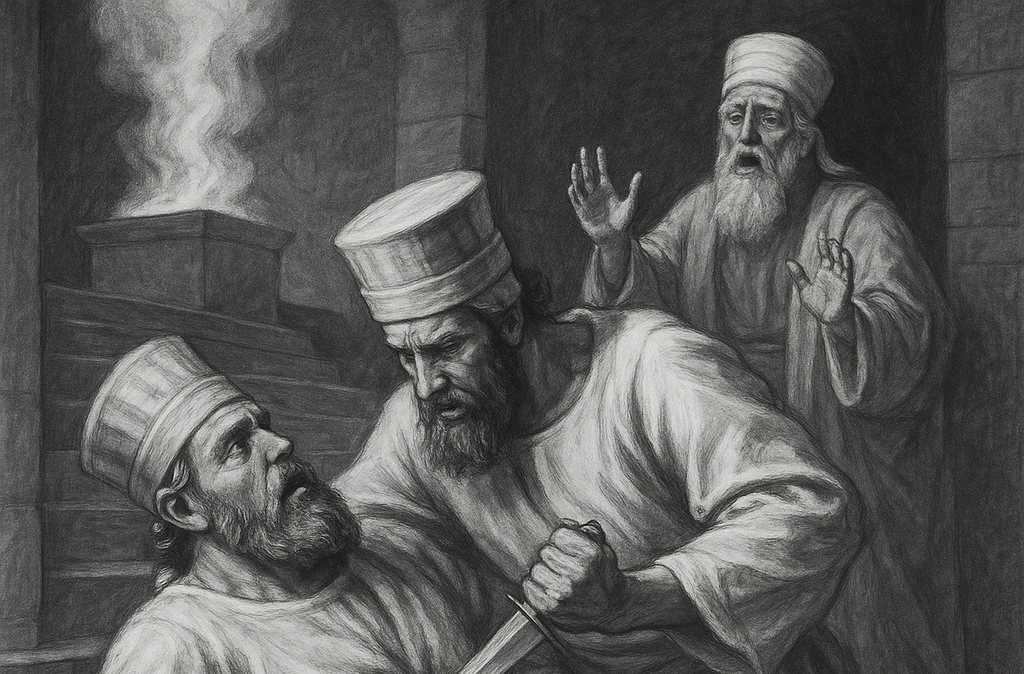
Rabbi Dr. Sharon Shalom in a recent article in the “Shabbaton” newspaper, explores the tension between rigid rules and lived reality, illustrating it with a modern case in France where a rape victim was accused of racism merely for accurately describing her attacker. He compares this with Talmudic stories of misplaced priorities before the destruction of the Second Temple, where ritual concerns outweighed those of human life. In one story, one Priest stabs another, and the wounded Priest’s father is more worried about how this affects the ritual status of the knife than the fact that life force of his son bleeding out.
Rabbi Shalom warns that when ideology becomes detached from common sense, it leads to moral blindness, a danger faced today as democratic values collide with complex realities. Using the example of defining Jewish identity—whether it derives from the mother or the father—he contrasts rabbinic Jewish law with the Bete Israel (Ethiopian Jewish). For thousands of years, Ethiopian Jewry determined “Who is a Jew?” based not solely on lineage but rather by upbringing, intention, and choice. This living Oral Torah, he argues, preserves flexibility and vitality, offering a model for balancing principles with the complexities of human life.
The original article in Hebrew can be read here: https://shabaton1.co.il/?p=42489
A full translation is below:
Between Rules and Reality
Rabbi Dr. Sharon Shalom
“Shabbaton”
A woman in France was raped by a stranger. She went to the police, and while she was trying to describe her attacker, it was clear from her description that he was a Muslim immigrant. She did not generalize—she simply described the person who had harmed her. And the reaction? She was accused of racism and of generalizing, as if her testimony implied that “a Muslim” had raped her. This, to me, reflects a way of thinking where facts that are uncomfortable are pushed aside in favor of protecting an abstract value, even when that value is misapplied. This way of thinking today leads intellectuals, in Israel and abroad, to focus their compassion on hungry children in Gaza—while there are still hostages, while we are in the midst of a war, while families are burying their children, while people live with wounds, bereavement, and trauma for 20 years. Meanwhile, the state funds Gaza—with electricity, water, and money—from which came the massacre of October 7. In the eyes of these critics, the party ultimately to blame is the State of Israel—not the perpetrators—an inversion of moral logic that mirrors the French case.
Another story reflecting a fatal misapplication of rules at the expense of compassion, appears in the Talmud: it tells of two priests ascending the ramp of the altar to offer a sacrifice. One gets ahead of the other cutting him off. The other, feeling his honor insulted, pulls out a knife and stabs his colleague in the heart—all this inside the Holy Temple. When the father of the injured man arrives and sees his son dying, he does not rush to help him but rather exclaims with relief: “The knife has not become ritually impure!”
What is the common thread between these stories? A conflict between values, between ideology and reality. Sometimes rules exist to regulate life, but when they become detached from common sense and human reality, they turn into moral blindness. In the Talmudic story above, the baraita concludes with a chilling insight: these people were more concerned with the ritual purity of utensils than with the spilling of blood.
Jewish society on the eve of the destruction of the Second Temple was so preoccupied with procedures and rules that it lost its feeling, morality, and grip on reality. The Western world—especially Europe—now stands in a similar situation to that of Zechariah ben Avkulas, one of the sages and judges before the destruction. When a disqualified offering, brought by Bar Kamtza who had been deeply insulted, was presented to him, Zechariah did not know how to act. If he accepted it, he would violate halakha; if he rejected it and punished or expelled Bar Kamtza, people would say, “One who blemishes offerings is to be killed.” In the end, he chose to make no decision. His refusal to act marked the beginning of the end. Rabbi Yohanan said: “The humility of Rabbi Zechariah destroyed our House.” Perhaps not humility—but inaction. Perhaps not patience—but moral blindness.
Even today, it seems the world is faced with a painful reality that collides with democratic values. The question is: What do we choose? What matters more—the rules or reality? In his famous “I Have a Dream” speech, Martin Luther King Jr. expressed a simple and correct hope: “That one day my children will be judged not by the color of their skin but by the content of their character.” But what happens when reality does involve skin color or origin, and when that is relevant to the facts? Will we cling to rules even when it’s clear they are blind to complexity? And what can we learn from Ethiopian culture on this matter?
For example: Is a person’s Jewish identity determined by the mother or the father? This question continues to spark debate in rabbinic tradition to this day. At its core lies a dilemma between two criteria: the objective criterion of Jewish law, and the subjective criterion of personal identity. On one hand, some see Jewishness as a matter of self-identity and say, “A Jew is someone who sees themselves as a Jew.” On the other hand, halakha states unequivocally: A Jew is someone born to a Jewish mother or who has converted according to halakha. Both the subjective criterion (sense of belonging) and the objective criterion (law) are important—the problem arises when they do not align. That is where the gap, and sometimes the rift, begins. In religious terms, it is the split between the Written Torah (law, procedure, objectivity) and the Oral Torah (life, interpretation, changing reality).
And what is the Ethiopian tradition’s view? In the Ethiopian Jewish community, there is a unique approach: a Jew is one born to a Jewish father—not necessarily to a Jewish mother—unlike rabbinic tradition. However, according to Qes Berhan, this determination is not only biological but also legal. The father decides where the child will be raised, but the child’s Jewish identity is not determined by lineage alone; it depends on the environment in which they grow up. Belonging to the Jewish nation is not dependent on biological origin, but on intention and choice. A child who grows up in a Jewish community, is educated there, and chooses to bind their fate with the fate of the people is considered a full Jew—much like a rebirth. This may be the only Jewish community that still possesses a living Oral Torah, one that has never been written down and is preserved as a living memory. Perhaps this is its secret: the ability to maintain the tension between rules and reality without losing vitality, flexibility, and beauty. This is a dual challenge—both for the free Western world and for the world of halakha and tradition.