- About Us
- Programs
- International School
- Support Us
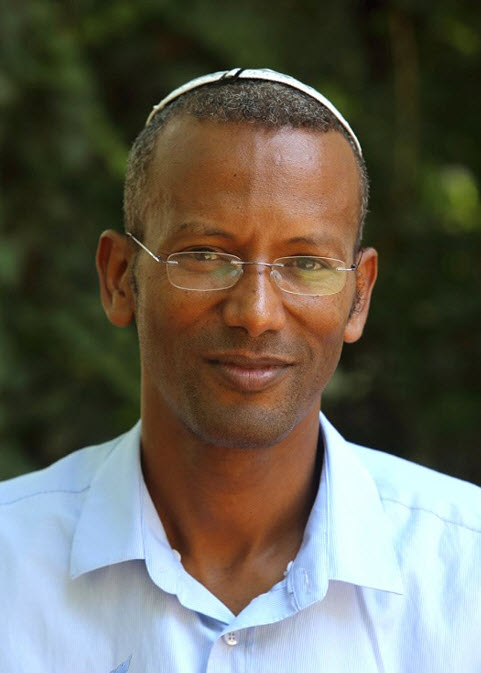
In an interview with the magazine, “Shabbaton”, Rabbi Dr. Sharon Shalom, the founder and director of Ono Academic College’s International Center for Ethiopian Jewry, shares his journey from a childhood in an isolated Ethiopian village to spiritual leadership in Israel. He highlights the evolving acceptance of the Ethiopian Jewish community, differences between their biblical customs and rabbinic law, and the controversy surrounding his book “From Sinai to Ethiopia.” Shalom discusses the unrecognized status of the Keisim (traditional Ethiopian Jewish spiritual leaders), founding the International Center for the Study of Ethiopian Jewry at Ono Academic College, and reconciliation efforts within the community. On Jerusalem Day, he calls for humility and unity, urging Israel to embrace its diverse heritage and resolve issues like that of the Jews who remain in Ethiopia.
Below is a translation of the article. The full article can be read in Hebrew at: https://shabaton1.co.il/?p=41366
Director of the International Center for the Study of Ethiopian Jewry at Ono Academic College
In an in-depth interview, Rabbi Sharon (Zeude) Shalom, PhD in Philosophy, Rabbi of the “Kedoshei Yisrael” community in Kiryat Gat, and Director of the International Center for the Study of Ethiopian Jewry at Ono Academic College, reveals his captivating life story—from his childhood in Ethiopia to his spiritual leadership in Israel. He describes the positive shift in societal attitudes toward the Ethiopian community (though there’s still a way to go), unique differences between community customs and rabbinic law, and the harsh reactions he faced upon publishing his book. Plus: What does he wish for the nation on Jerusalem Day?
My childhood in a small village in northern Ethiopia was enchanting, a kind of disconnected world. It felt as if there was no world beyond the few villages I knew. Truly, life was like in the biblical verse, “You shall be simple with the Lord your God.” The realization that the only world you know is your village and its surroundings wasn’t a disadvantage; today, I understand it was a great advantage. When a person lives with the consciousness that their small village is their entire world, it’s a mindset of peaceful, tranquil, and even innocent living.
Our village was exclusively “Israelite” (the word “Jewish” wasn’t used). Judaism was evident everywhere: in the synagogue at the village center, at the house for menstruating women or those ritually impure, down by the river. On Shabbat, no one worked; everyone sat in shared family courtyards and didn’t leave the village boundaries. We only went to the synagogue (“masgid” or “tzolot beit”). I thought then that if I walked straight to the end of the world, I’d touch the sky, believing the sky and earth connected somewhere at the edge. One thing was clear: there was a place called “Yerusalem” (Jerusalem). Everyone spoke of it. Jerusalem was a dream, a hope—a place wrapped in gold, flowing with milk, truly a Garden of Eden. This hope was passed down through generations. Some fasted nine days to commemorate the destruction of the First Temple, and in Av, a 17-day fast from the start of the month to the 17th. During prayers, they always faced Jerusalem. Even when slaughtering an animal, its head was turned toward Jerusalem. The Sigd holiday entirely expresses this longing, but mainly the renewal of the covenant. Most surprising: while the Jewish world prays to ascend to Jerusalem, Ethiopian Jews prayed to descend to Jerusalem. Once, my friend Maspin, a brave and clever boy, and I ran away from the village without telling our parents to get to Jerusalem. We were only 7 and 9 years old. Today, I can’t believe we did it. You can only imagine the yearning and passion.
The Mishnah in Avot says: “At five for (the study of) Scripture, at ten for (the study of) Mishnah…” But in Ethiopia, it was different. I studied only one year in school, and then we were forbidden to learn. I was a young child, not yet a shepherd, only a “deputy shepherd.” There wasn’t a culture of formal education like there is today. There were no study halls for children. Historically, only small groups dedicated themselves to Torah study, not the masses. In Ethiopia, as elsewhere, only a few engaged in sacred studies, usually to prepare for spiritual roles. Tradition wasn’t passed through classrooms and books but through personal example from the home: behavior, tradition, and the way of life from those around the village and household. The tradition seeped into the heart like quiet waters. It’s unforgettable. To this day, I remember my grandfather finishing the Book of Psalms, “Mizmorei David,” in the early morning hours.
When thinking of gaps, we imagine a hierarchy—what’s above and what’s below. But the encounter between Ethiopian Jewry and Israeli society was, in my view, a “historical accident”—a meeting of two consciousnesses, two models of Judaism: the biblical and the halachic-Talmudic. Ethiopian Jewry preserved the biblical tradition with devotion, and the mental, cultural, and linguistic gaps were profound.
After arriving in Israel, which is a story unto itself, I studied in religious boarding schools before the higher level yeshiva and received much warmth and love. But entering a hesder yeshiva was a different story, a different world: depth, scope, pace of study, and especially if you choose the path to rabbinic ordination.
The first step is acknowledging the gap, understanding there’s a path to bridge it. It’s tough, but it also pushes you to work twice as hard. What helped me? Rabbis and friends who embraced and supported me. The head of the kollel at Yeshivat Har Etzion, Rabbi Shlomo Levi, may he live long, once told me: “Invest in study, dive deep. When you become a rabbi, your influence will be significant.” I remember my father asking me in my first year: “What are you studying?” I answered, “Torah.” In the second year: “And now?” Again, “Torah.” By the third year, he asked in surprise: “What about math?” Unlike my father, who didn’t quite understand what I was doing in yeshiva, my late mother understood and always gave me encouragement, love, and support.
It’s clear that the absorption of Ethiopian Jews came with difficulties. Israeli society, like any society, has good and bad. You can see its amazing sides and its painful ones. The gaps were immense—cultural, religious, linguistic. Yet, 40 years after the Ethiopian Aliyah began, the Ethiopian community has become an integral part of the Israeli fabric. Many have broken glass ceilings, integrated, and led. It’s impressive and testifies to the community’s inner strength, faith, and perseverance. Someone once told me that Israeli society doesn’t discriminate—it just “challenges” everyone. Yemenite, Moroccan, Soviet immigrants—all faced hardships. A Yemenite PhD once told me in pain: “How can you speak so well of this country when they took our children?” I replied with a smile: “At least they bought you. No one wanted to buy us…” The message? Don’t be naive, but don’t be cynical either. Understand that reality is complex, not black-and-white.
Have you noticed a change in societal attitudes toward the community in recent years?
Absolutely, we’ve undergone an amazing process. Compared to decades ago, when, for example, Rabbi Samson Raphael Hirsch wrote that relations with a Black woman were against reason and morality, today 18% of Ethiopian-origin marriages are with other communities. In the U.S., for comparison, the rate of Black-White marriages is only 6%. This says something about Israeli society. True, the starting point was very tough. A Jewish tribe, a splendid community, had its Jewishness denied, its Aliyah delayed for various reasons—sometimes against Halacha—and some rabbis and scholars opposed its integration as equals, which is unthinkable. Often, fear trumped love. “Pure” halachic considerations were distorted, and instead of a simple solution for dealing with the Jewishness issue, like immersing in the mikva, people were subjected to humiliating processes. Yet, the community chose life, like Holocaust survivors—not to dwell on the past but to push their children toward success and a better future.
Israeli society has also changed, beginning to discover the depth, beauty, and treasures of Ethiopian Jewry. Prof. Yigal Yadin said after the Six-Day War, when asked in Europe why Arabs opposed Jerusalem excavations: “Because the deeper you dig, the more you uncover Jerusalem’s Jewishness.” Ethiopian Jewry is like Jerusalem: to understand it, you must dig deep. Then you discover its strength and biblical roots.
When we were preparing our marriage, my wife told the clerk at the Ministry that she immigrated from Switzerland. He asked, “Why did you come to Israel?” She replied simply, “Because we’re Zionist Jews.” Amazed, he said, “I wouldn’t have done it in your place…” When he got to me, he said, “You, I understand. Moving from Ethiopia to Israel makes sense.” He meant that Aliyah from Ethiopia was an escape from exile, but from Europe? That’s a sacrifice. Here, too, the driving force was love—love for Zion, Israel, and faith. This principle applies to our society. We must base our connections on love, not fear.
When the “Kedoshei Yisrael” synagogue committee, founded by Holocaust survivors, decided to appoint me as rabbi, a journalist asked them: “How did you accept an Ethiopian rabbi?” They replied: “We were in the Holocaust, suffered selection for being Jews. How could we reject someone for their skin color? We don’t seek color; we seek knowledge. We don’t know an Ethiopian; we know Rabbi Sharon.” When you know the person, barriers fall. That’s how we act at home—and how we’d like the entire nation to act.
I’ve sadly heard harsh statements from yeshiva students, including those of Ethiopian descent and Haredim, against the Kessim: “Heretics,” “illegitimate.” I was at a wedding where a Keis was blessing the couple under the chuppah, and one of the guests asked, in shock: “How does this happen?” If such remarks come from within our own community, what will others say? The Rabbinate, it must be said, has never recognized the Kessim’s halachic status. The only recognition was a government decision, not from the Rabbinate. Still, in most cases, they’re treated as folklore, not spiritual leaders, which is unfortunate. The Kessim represent an ancient Jewish tradition that can greatly contribute to Israeli society. We’re not asking for favors; we’re offering a gift: a living tradition from the biblical world, preserved for centuries. The Rabbinate doesn’t “accept”; it can learn. We’re a “living genizah [storehouse for ancient holy books],” offering to restore spiritual worlds. We’re not alone in this. I learn much from Prof. Tova Hartman, noting significant parallels between attitudes toward gender issues and the Rabbinate’s stance on the Kessim. In both cases, it’s about power dynamics, exclusion, and inequality disguised as halachic stances but rooted in deep social biases. Often, what’s permitted for one group is forbidden for another, revealing hypocrisy and a lack of integrity.
The debate between the rabbinic world and the world of the Keisim world isn’t just a manifestation of racism. It’s a clash between two belief systems: Talmudic and biblical. Each sees things differently: what the Rabbinate views as a severe violation is, for the Keisim, an accepted spiritual norm. Circumcision by women, delaying circumcision from Shabbat to Sunday, giving money on Shabbat as an offering, Kiddush on Yom Kippur that falls on Shabbat—these are seen as halachic violations but are ancient laws for Ethiopian Jewry. More examples include: not waiting “seven clean days” after menstruation ceases (as required by Rabbinic Judaism) but instead immersion on the seventh day, a ban on visiting cemeteries (which is seen as idolatry), no prohibition on eating poultry with milk, a prohibition on marital relations on Shabbat. Clearly, there are gaps, and the question is how to bridge them. Unfortunately, the meeting between these worlds was judgmental, not one of dialog.
To change this, we need mutual listening and understanding. I paid a heavy price when I published my book From Sinai to Ethiopia, despite working with rabbis within an Orthodox framework. It didn’t help. The challenge isn’t just halachic but social and political. How do we preserve uniqueness while living together? That’s the question of our time.
I currently am the director of the International Center for the Study of Ethiopian Jewry at Ono Academic College—the world’s first academic center dedicated to researching and teaching about Ethiopian Jewry. When I first proposed the idea at another institution, I was told: “First prove they’re Jews.” But at Ono Academic College, it the concept was embraced with love, aligning with a multicultural and diverse academia.
Today, I see how much Ethiopian Jewry sparks interest, not only in Israel but also in the Jewish diaspora. Together with Martin Hershkowitz (founder of the “Creating Memory” non-profit organization and the son of Holocaust survivors), we wrote a curriculum in English to teach about Ethiopian Jewry, that was recommended by renowned educator Dr. Haim Peri. The curriculum’s author is Rabbi Johnny Solomon, and the ideas naturally stem from the work of Ono’s Ethiopian Center. This program teaches Jewish students worldwide about Zionism, Aliyah, and Jewish identity through the story of Ethiopian Jewry. In Israel, too, there’s a shift. Slowly, Israeli society is discovering Ethiopian Jewry not only in its religious and traditional aspects but also through culture and cuisine. The community and Israeli society are learning from and opening up to each other. Less struggle, more partnership. That’s exactly what we aspire to: every sector in Israel seeing the treasure of the other. Each group brings a deep spiritual and cultural language, and if we “read” it correctly, we all benefit.
The International Center at Ono has also brought change to academia. It’s not simple—it’s a shift in discourse, a paradigm change. No longer just a populist narrative but a deep, respectful academic dialogue. We’ve established a Beit Midrash (study hall) for Ethiopian texts for the first time. Outstanding graduates sit, study, interpret, and pass on this language and culture to other groups and the next generation. Groundbreaking articles are being written. We believe this language, the language of Ethiopian Jewry, can bring great light to Israeli society.
Clearly, the Ethiopian community isn’t monolithic. Even within the community, there were always disagreements, even in Ethiopia, and certainly after Aliyah to Israel. There were disputes over accepting the Rabbinate, preserving local traditions, what to maintain, and what to change. Additionally, missionaries in Ethiopia influenced some groups to convert to Christianity, creating internal tension even before Aliyah. Two years ago, we launched an important reconciliation process at Ono’s Ethiopian Center, guided by community leaders who conducted serious research and community work. The summary conference was moving: Keisim, Haredi rabbis, and a Religious Zionist Rabbi, all of Ethiopian heritage, stood together on one stage. This says it’s possible. But for it to happen, internal responsibility is needed—not blaming others but taking community responsibility. Today, thank God, there’s a rapprochement between the groups. No longer “Bete Israel” and “Falash Mura,” but Bete Israel, one family. It’s moving and blessed, and we see that it’s working when members of the groups marry each other. This is an amazing community—an asset, not a burden, to Israeli society.
Recently, a U.S. school principal who visited the Gondar camp asked me: “Why doesn’t the state bring them up?” They pray, there are split families, the situation is tough. It’s a very painful story, not just from a Jewish perspective but a human one. The state can’t leave people hanging. A decision is needed: either return them to their villages or bring them to Israel. The plan already exists, drafted with the “P’nima” organization, and I was involved. It just needs implementation, and sadly, it’s not happening. In my view, there’s disregard for this group. Some should have immigrated long ago under the Law of Return but haven’t. There’s confusion, disorder, and indecision. It’s time to resolve this story clearly and fairly.
When I started writing the book, I didn’t imagine the storm it would cause. Rabbi Prof. Daniel Sperber recognized its importance early on, so he pushed, guided, and personally funded it. The book reached senior rabbis’ desks, including the Chief Rabbi, and faced bans, threats, and harsh phone calls, and I still feel the echoes today. But I now understand it was worth the price. If in the past no one knew the term “Ethiopian Halacha,” today even those who opposed the book want to read it. Disagreement is legitimate, but there’s a difference between substantive opposition and personal attacks. Sadly, some responses crossed all bounds of decency. It wasn’t easy for me or my family. But to change consciousness, you need courage and patience. It’s a process. The book, translated into English, is now in study halls worldwide—from the U.S. to South America. It’s slowly becoming part of the Jewish mosaic, which, in my view, is a tremendous achievement.
I said earlier that Ethiopian Jews don’t pray to “ascend” to Jerusalem but rather to “descend” to it. It’s not a physical act but as a symbol of descending to the other’s world, listening to them, looking at them eye-to-eye with closeness and humanity. Not to rise above but to meet them from a place of partnership and humility.
In these days, we especially need this consciousness—of modesty, listening, and seeing the other. Jerusalem, undivided among tribes, symbolizes unity, the idea that all Israel are friends. The State of Israel is a great light, a great miracle, and simply, a gift not to be taken for granted. Please, let’s preserve it.