
- About Us
- Programs
- International School
- Support Us
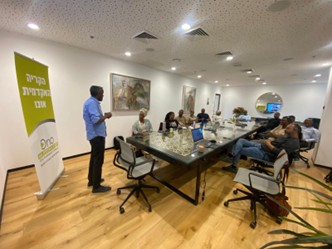
The most recent meeting of the Beit Midrash for the Study of Ethiopian Jewish Religious Texts at Ono Academic College hosted Adv. Yaakov Gonchell who explored the Təʾəzaza Sänbät, a sacred Beta Israel Ge’ez-language text attributed to 15th-century convert Abba Ṣabra. The book is a Sabbath-focused compilation blending Enochic, aggadic, and near-kabbalistic elements with Islamic and Christian influences, featuring unique cosmological and midrashic content.
Gonchell, who works in the Israel government controller’s office and is pursuing a Ph.D. on Beta Israel practices, highlighted the importance of understanding pre-Second Temple Judaism to contextualize Beta Israel traditions, which differ from Rabbinic Judaism. Before the Temple’s destruction in 70 CE, Jewish life revolved around priestly sacrifices, with minimal lay involvement and no synagogues. Post-destruction, the rabbis shifted focus to study halls, adapting Judaism to survive without the Temple, while groups like the Prushim, Tzdukim, and Essenes held diverse beliefs.
Gonchell began by discussing the Beta Israel canon that includes apocryphal texts like the Book of Jubilees and Book of Enoch, preserved by the Ethiopian Church. With this background, Gonchell began to discuss the book of Sabbath Laws, the Təʾəzaza Sänbät which relates to these apocryphal books.
The Təʾəzaza Sänbät, a sacred Beta Israel text in Ge’ez attributed to 15th-century convert Abba Ṣabra, is a Sabbath-focused compilation blending Enochic, aggadic, and near-kabbalistic elements with Islamic and Christian influences, featuring unique cosmological and midrashic content. It forms part of the Beta Israel’s Mäṣḥafä Kedus, alongside the Orit and apocryphal texts like Enoch and Jubilees, emphasizing Sabbath observance and a syncretic theological tradition.
The book includes many fascinating aspects including personifying the Shabbat as female, and unique laws, such as the prohibition of marital relations on Shabbat (something encouraged in the Rabbinic Jewish tradition). Notably, Beta Israel tradition does not place pikuach nefesh (saving a life) above Shabbat, unlike Rabbinic law since the time of the Maccabees. The discussion underscored that Beta Israel practices align with pre-Temple Jewish traditions, validating their distinct identity.
Participants explored their final project topics, including Beta Israel music, ritual slaughter, Moses’ portrayal, and mourning practices, with plans for future meetings to continue these discussions.
In a question and answer session, Rabbi Reuven Yaso answered heartfelt questions including on whether the Beta Yisrael spiritual leadership today is qualified to pass down the ancient tradition to Ethiopian Jews living in Israel.