- About Us
- Programs
- International School
- Support Us
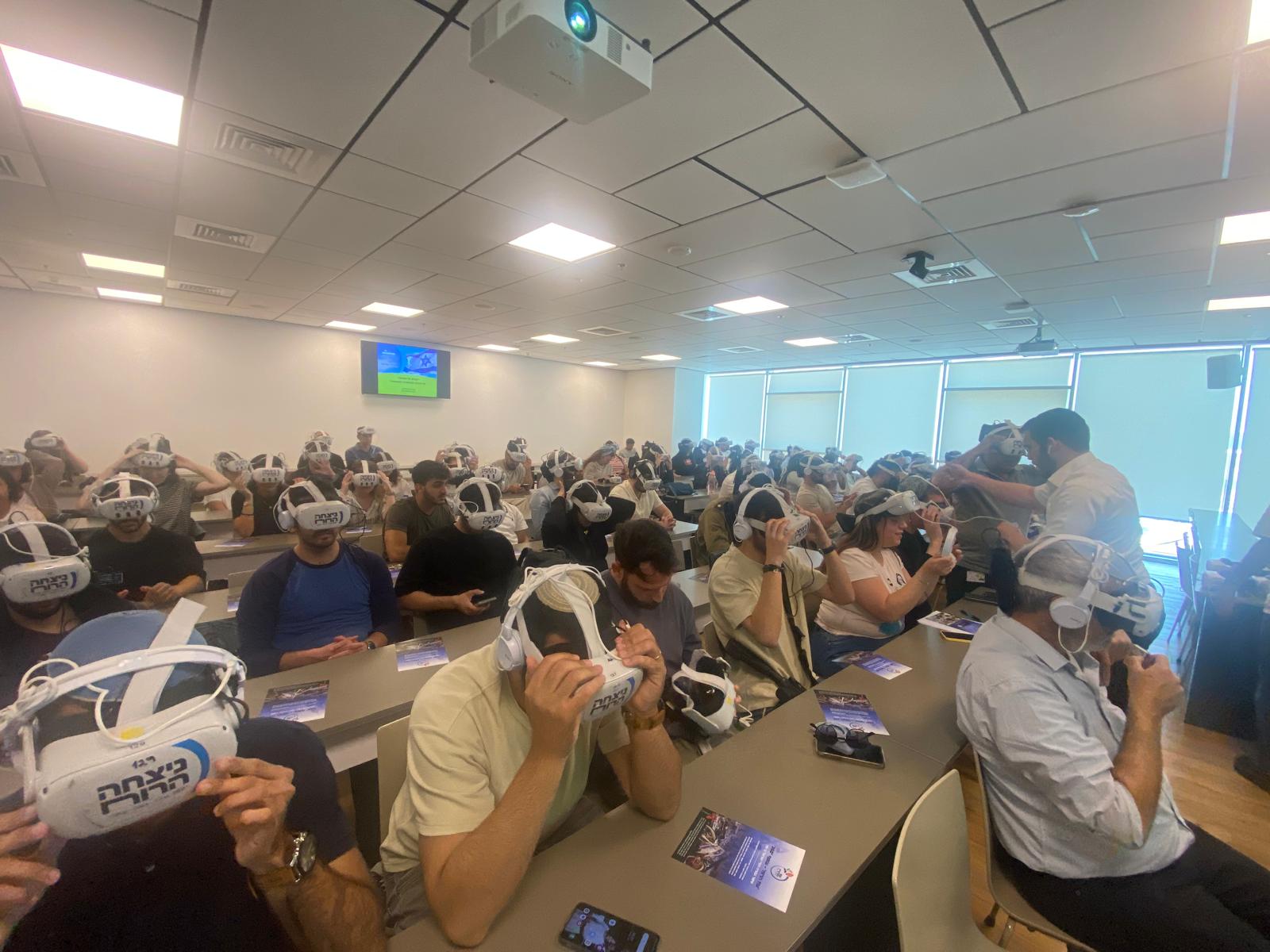
Ono Academic College’s Religious Zionist Authority invited dozens of students to a powerful Virtual Reality (VR) experience focused on the events of October 7th. The event featured an introduction by the program’s co-founder, the VR presentation itself, and a follow-up discussion.
Miriam Cohen, co-founder of the Nitzcha Haruach (Triumph of the Spirit) organization, shared the origins of the VR project. She explained that many ultra-Orthodox Jews, due to religious restrictions, cannot join Holocaust education trips to Poland, which are common among other Israeli sectors. To address this, Cohen and her partner, Chani Kopilovtich, developed a VR experience that immersively transports users to sites like the Auschwitz concentration camp. During the COVID-19 period, Cohen traveled to Poland, gaining special access to film these sites using advanced cameras and drones, creating a vivid sense of presence. The program has been embraced by Israel’s education system, enabling thousands— including Jews, Arabs, Druze, and international audiences—to virtually visit these sites.
Following October 7th, Cohen and Kopilovtich felt compelled to document the devastation in Israel’s Gaza envelope and the Nova festival. Cohen described the emotionally grueling process, driven by a sense of national duty to capture the atrocities and share them globally. The resulting VR experience, “Oz Veruach (Strength and Spirit),” was adopted by Israel’s Ministry of Diaspora Affairs and used by hostage families in international advocacy efforts. The Israel Defense Forces (IDF) also employs it to educate soldiers. A tailored version for ultra-Orthodox Jews uses culturally sensitive language to address their religious needs.
Rabbi Moshe Reiss of Ono’s Religious Zionist Authority aimed to make this experience accessible to as many students as possible. Demand far exceeded available spots. The version shown to Ono students was slightly less graphic than the one used for public diplomacy.
The VR experience opens with aerial views of the Nova festival and Gaza envelope settlements before October 7th. A narrator guides participants through newsreels of the attacks, then transitions to the aftermath: piles of burnt cars, memorials for those killed at Nova, and destroyed homes in villages like Kfar Aza. The program highlights heroic stories of those who fought and perished, with families of hostages and victims sharing their accounts.
The program makes good use of the magic of VR to enable participants to viscerally understand the events. In one poignant moment, participants stand virtually in a safe room where Jewish residents hid from the terrorists. A mother of a victim points to the entry hole of an RPG fired by Hamas, and then asks participants to turn their heads to see the shrapnel’s impact on the wall behind. As the participant physically turns around, he/she has the profoundly chilling revelation that the shrapnel would have passed right through their bodies in that confined space.
The experience continues with virtual tours and interviews with survivors, hostage families, and relatives of the murdered. For some students, the intensity was overwhelming, prompting them to remove their VR headsets. Afterward, Cohen facilitated a discussion to help participants process the harrowing experience.